China Best WiFi Carbon Monoxide Detector Manufacturers
Carbon monoxide is colorless and odorless, so people may not notice a leak until symptoms appear. The World Health Organization identifies it as a toxic gas produced by incomplete combustion. The stakes are real. The U.S. Centers for Disease Control and Prevention estimates that more than 400 people die from unintentional carbon monoxide poisoning in the United States each year, with over 100,000 emergency department visits. These figures make dependable detection more than a convenience.
A Wifi Carbon Monoxide Detector can send an alert to a phone, but connectivity alone does not establish product quality. Buyers assessing China’s manufacturers should look beyond app screenshots. Ask about sensor type and service life, calibration and production checks, alarm testing, documented performance, and support for the target market’s applicable standards. UL 2034, for example, is a U.S. performance standard for carbon monoxide alarms; buyers should verify the exact model’s certification rather than assume it applies to every product from a supplier. Also check how the alarm behaves when Wi-Fi or household power fails. A local audible warning still matters. Details matter.
This guide examines the capabilities and manufacturing practices buyers can verify when comparing suppliers. Factory claims deserve careful review, and specifications can be easy to misread. A connected device may offer faster notifications, yet it cannot guarantee that a warning is received or acted upon. Strong sourcing decisions depend on traceable test evidence, clear technical documentation, and realistic evaluation of each model’s limits.
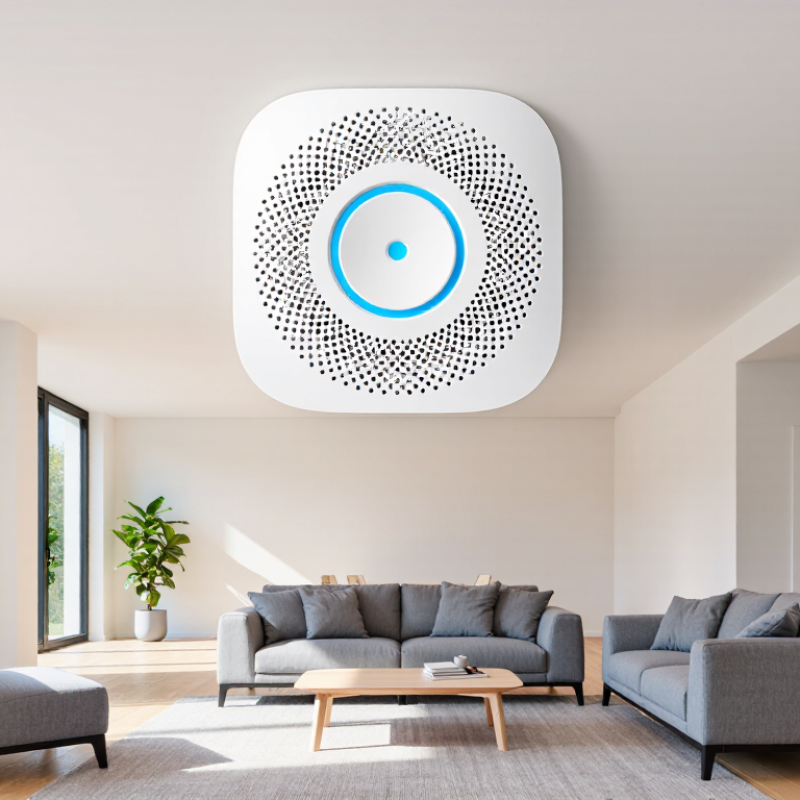
What Is a WiFi Carbon Monoxide Detector and How Does It Work?
A WiFi carbon monoxide detector uses a sensor to monitor the air for carbon monoxide, an invisible, odorless gas. Many models use an electrochemical sensor: when CO reaches its sensing element, a chemical reaction creates a measurable electrical signal. The device compares that signal with preset thresholds. If levels meet its alarm criteria, the built-in siren sounds. The sensor does the detecting. WiFi does not.
When connected to a home network, the detector can send an alert to a phone app. Depending on the model, notifications may include an alarm event or low-battery warning. This can help when nobody is near the unit, but only if the router, power supply, and notification settings work. A weak signal can interrupt updates. That part is easy to overtrust.
The detector should still be installed and maintained according to its instructions. Choose a location recommended for the specific model, and keep vents clear. Pressing the test button checks the alarm circuit; it does not confirm that the sensor can detect CO accurately. Check the device’s service life and replace it when required. Small details matter. A phone alert is useful, but it should never replace the local alarm or a prompt response to a warning.
Key Safety Standards for WiFi Carbon Monoxide Detectors in China
For a WiFi carbon monoxide detector sold in China, safety starts with dependable sensing, not the phone app. Check the standard and test report applicable to the exact model. GB/T 34004-2017 is a relevant reference for household carbon monoxide alarms; confirm its current status and scope before relying on it. Details matter.
A useful test report should identify the sensor, alarm response, sound level, and operating conditions. Ask how the unit behaves after a power cut or WiFi failure. The local alarm must remain audible without an internet connection. Check that instructions explain installation height, placement, and sensor-life limits in clear language. Small omissions can become real problems.
Wireless features need their own checks. Verify whether the WiFi module meets applicable Chinese radio requirements, and make sure its approval covers the fitted module and product configuration. A certificate helps, but it is not the whole story. In a kitchen or hallway, a weak router signal may delay a phone alert; it should never delay the detector’s local warning. I would still compare the paperwork with the actual unit, including its model number and label. That step is easy to overlook.
How China’s WiFi Carbon Monoxide Detector Manufacturing Industry Operates
China’s WiFi carbon monoxide detector industry brings together sensor suppliers, electronics assemblers, firmware teams, and testing facilities. Production often starts with incoming checks for sensor modules, circuit boards, WiFi components, and plastic housings. On the assembly line, automated machines place components onto boards, while technicians inspect solder joints and connector alignment. Small details matter. A poorly seated connector can cause intermittent readings or prevent pairing.
After assembly, units are programmed and checked in controlled test stations. Technicians expose samples to measured carbon monoxide concentrations to verify sensor response and alarm behavior. They may also test WiFi setup, signal recovery after a router disconnects, and performance across temperature and humidity changes. Not every factory applies the same depth of testing, so buyers should ask about calibration records, batch traceability, and ongoing quality checks. The less polished part of production is often consistency: a sound prototype does not guarantee every batch performs identically. Reliable designs keep a local audible alarm available when internet access fails; an app connection should add convenience, not replace the detector’s basic warning function.
How to Evaluate Chinese WiFi Carbon Monoxide Detector Manufacturers
When evaluating Chinese WiFi carbon monoxide detector manufacturers, look beyond product photos and advertised features. Ask what sensing technology is used, how each unit is calibrated, and how sensor performance is checked across production batches. Request sample test reports and clear explanations of alarm behavior. A polished sample is not enough. Production consistency matters.
Check whether the detector continues sounding if WiFi or household power fails. Ask for details about backup batteries, low-battery alerts, app notifications, and reconnection after a router outage. Test these functions on a sample unit, rather than relying only on a feature sheet. Also review the user manual for plain instructions on installation, testing, and sensor replacement. Small details reveal a lot.
Evaluate the factory’s quality controls, traceability, and response process for defective units. Ask how support staff handle technical questions and whether replacement parts are available. Confirm that product claims and test documents match the exact model being quoted; similar-looking versions may differ. A dashboard can look excellent while a delayed alert remains hard to notice. That deserves a real test. Some suppliers may not share every internal record, so compare the evidence they do provide and note what remains uncertain.
China WiFi Carbon Monoxide Detector Manufacturers: How to Evaluate Them
Compare a manufacturer’s independently tested alarm response times with the limits shown below. These are EN 50291-1 test requirements, not performance data for any manufacturer or product.
At 50 ppm, an alarm should sound within 60–90 minutes; at 100 ppm, within 10–40 minutes; and at 300 ppm, within 3 minutes. At 30 ppm, the detector must not alarm within 120 minutes. Ask manufacturers for test reports from an accredited laboratory and verify the applicable standard edition and certification scope.
Factors to Consider When Selecting a Manufacturer in China
China Best WiFi Carbon Monoxide Detector Manufacturers
When comparing manufacturers in China, look beyond unit price and polished product photos. Ask how each detector is calibrated, which sensing technology it uses, and how alarm performance is checked across production batches. Request sample test records, component traceability, and a written quality-control process. A factory visit or video audit can show whether calibration stations and final alarm checks are actually in use. Details matter.
Tips: Send every supplier the same technical brief. Specify WiFi requirements, app language, power source, backup behavior, alarm volume, and operating temperature. Test several samples, not only the handpicked unit. Ask who handles firmware updates and defect reports after shipment. Keep answers in writing.
Assess engineering support and communication, too. A reliable manufacturer should explain limitations clearly, including what happens during connectivity loss and how the device signals a fault. Confirm that documentation matches the exact model and intended sales region; requirements vary, so verify them independently. It is easy to focus on the sensor and overlook packaging or app pairing. Include both in pilot testing before placing a larger order.