
Modern warehouses face tighter space, faster order cycles, and higher service expectations. Pallet Flow Racking addresses these pressures through gravity-driven storage lanes. Pallets enter from the loading side and move on rollers toward the picking side. This arrangement supports first-in, first-out inventory rotation when designed correctly.
The system suits high-volume products with consistent pallet dimensions. It can reduce forklift travel and create clearer separation between replenishment and picking activities. Zebra Technologies’ 2023 Global Warehousing Study reports that 58% of warehouse decision-makers expect to deploy robotics by 2028. That finding reflects a broader shift toward measurable, technology-supported efficiency. However, Pallet Flow Racking remains mainly a mechanical solution. It does not replace accurate inventory data or disciplined warehouse practices.
In practical design reviews, engineers examine pallet weight, carton friction, lane length, roller pitch, and product turnover. A small mismatch can cause pallets to stop halfway. A damaged pallet can create a serious obstruction. MHI’s 2024 Annual Industry Report also highlights continuing investment in automation, visibility, and supply-chain resilience. Pallet flow systems support these goals, but only when connected to suitable warehouse processes.
It is not a magic answer.
The uncomfortable question concerns product variety. Too many stock-keeping units can reduce lane utilization and complicate replenishment. Operators must also inspect brakes, rollers, guides, and rack frames regularly. A system may look efficient on paper yet perform poorly on a busy shift. This guide explains what Pallet Flow Racking is, how it works, where it fits, and which design assumptions deserve careful review.
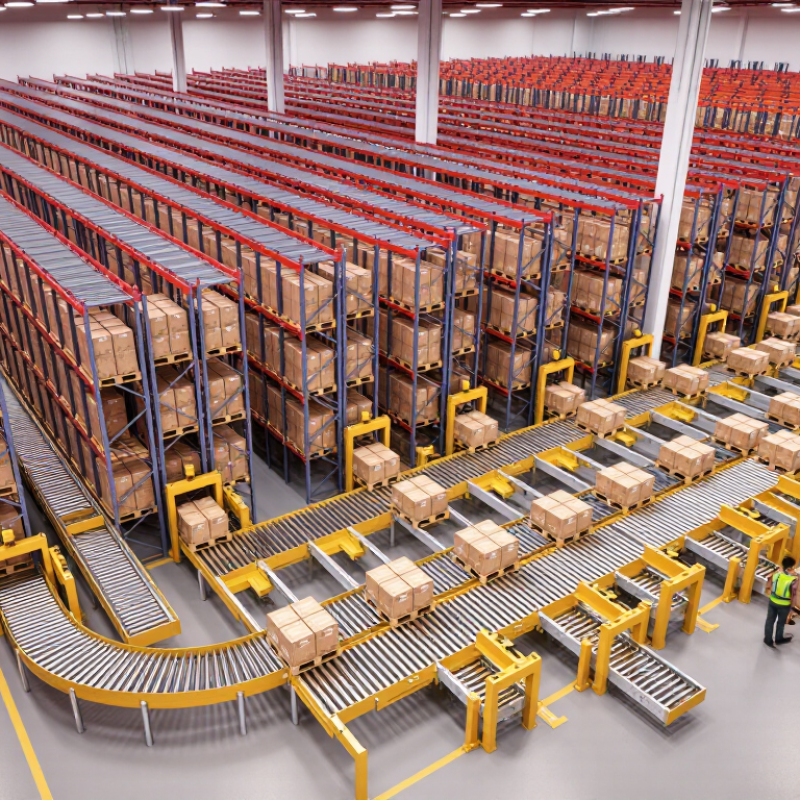
Pallet flow racking is a dynamic storage system for palletized goods. It uses inclined lanes fitted with rollers or wheels. Pallets enter from the loading side and move toward the picking side. Gravity does the work. Unlike static pallet racks, this system keeps products moving through each lane. It is commonly designed for first-in, first-out rotation, especially when stock age matters. Each lane usually stores one product type, although warehouse layouts can vary.
During operation, workers load a pallet at the higher end. The pallet rolls slowly toward the lower end, where a stop, separator, or brake controls its movement. A picker removes the front pallet, and the next one advances into position. This creates a clear picking face and reduces travel through the aisle. In real warehouses, the result can be striking: fewer forklifts crossing the same space and less unnecessary handling.
However, pallet flow racking is not suitable for every load. Pallet dimensions, weight, packaging quality, and product stability must be checked before installation. Damaged boards may catch on rollers. Poorly wrapped cartons may lean or collapse. The slope also needs careful adjustment because excessive speed can create impact risks. From field observations, the most attractive layout is not always the most practical one. Operators may need training, regular inspections, and lane adjustments as products change. Small details matter here. A reliable design begins with actual pallet samples, measured traffic patterns, and honest discussion about daily warehouse habits.
| Data Dimension | Key Information | How It Applies to Pallet Flow Racking |
|---|---|---|
| System Definition | Gravity-based pallet storage system | Pallet flow racking is a dynamic storage system that uses inclined roller lanes to move pallets from the loading side toward the picking side. |
| Movement Principle | Gravity-driven pallet movement | After a pallet is loaded, gravity causes it to travel down the rollers without requiring a forklift to move it through the entire storage lane. |
| Loading Method | Load from the replenishment side | Forklifts place pallets at the higher end of each lane. The pallet then moves toward the opposite end as space becomes available. |
| Picking Method | Pick from the front-facing discharge side | Operators or forklifts retrieve the leading pallet from the lower end of the lane. The next pallet advances automatically into the picking position. |
| Inventory Rotation | First-in, first-out (FIFO) | Because pallets enter from one side and leave from the other, the system naturally supports FIFO rotation, which is useful for dated or time-sensitive goods. |
| Main Components | Frames, beams, roller lanes, brakes, guides, and stops | Rollers support pallet movement, speed controllers regulate travel, guide rails maintain alignment, and end stops help control pallet positioning during picking. |
| Typical Pallet Compatibility | Rigid, standardized pallets with suitable bottom support | Pallet dimensions, bottom-board design, load weight, and pallet condition must be checked to ensure smooth travel and stable support on the roller lanes. |
| Lane Configuration | One product type per lane is commonly preferred | Assigning the same stock-keeping unit to a lane simplifies replenishment and picking. Mixed loads may require additional controls to prevent sequencing or access problems. |
| Storage Density | High depth storage with fewer access aisles | Multiple pallets can be stored in a single lane, reducing the number of aisles required compared with many selective rack layouts and improving floor-space utilization. |
| Forklift Requirement | Forklifts are used mainly for loading and unloading | Forklifts do not normally enter the full storage lane. This can reduce travel distance inside the rack and help separate replenishment and picking activities. |
| Operational Efficiency | Continuous product presentation | As the front pallet is removed, following pallets move forward, keeping the next load ready for retrieval and reducing manual repositioning. |
| Best-Fit Applications | High-volume, fast-moving, or date-sensitive inventory | The system is well suited to food distribution, beverage storage, cold storage, manufacturing components, and other operations that benefit from FIFO rotation. |
| Temperature-Controlled Storage | Suitable for refrigerated and frozen environments | High-density storage and separated loading and picking faces can help reduce door-opening frequency and improve the use of temperature-controlled space. |
| Primary Benefits | Density, controlled rotation, and reduced travel | Key advantages include better use of storage volume, automatic pallet advancement, fewer aisles than some conventional layouts, and easier FIFO management. |
| Key Limitations | Less flexible access to individual pallets | Each lane is generally dedicated to a product or product group, so the system may be less suitable for low-volume inventory with many different stock-keeping units. |
| Maintenance Requirements | Regular inspection of rollers and control devices | Routine checks should cover roller condition, brake performance, lane alignment, end stops, guide rails, rack connections, and visible damage caused by handling equipment. |
| Safety Considerations | Load control and rack inspection are essential | Safe operation requires compliance with the rack designer’s load ratings, correct pallet placement, trained operators, clear work zones, and prompt reporting of damaged components. |
| Design Verification | Engineering review before installation | Rack height, lane depth, pallet dimensions, load characteristics, seismic conditions, building constraints, and material-handling equipment should be evaluated before the system is specified. |
| Comparison with Selective Racking | Higher density but lower direct selectivity | Pallet flow racking generally stores more pallets per aisle footprint, while selective racking normally provides more direct access to individual pallets and a wider range of stock-keeping units. |
| Performance Indicator | Lane utilization and pallet throughput | Operational performance can be assessed by measuring occupied pallet positions, replenishment frequency, picking rate, stock rotation accuracy, and equipment travel distance. |
Note: Actual capacity, pallet compatibility, lane angle, roller configuration, and load limits must be confirmed through a site-specific engineering assessment.