
Choosing among the 10 best LED strip lighting suppliers worldwide takes more than comparing prices. A bright sample can look impressive on a desk, then appear uneven beneath a kitchen cabinet. Buyers should check color consistency, light output, dimming compatibility, adhesive quality, and the supplier’s published product data. Ask about warranties and replacement support, too. Small details matter.
Lighting researcher Nadarajah Narendran, director of the Lighting Research Center at Rensselaer Polytechnic Institute, has helped advance understanding of solid-state lighting. A careful paraphrase of a principle reflected in this research is: “Evaluate the complete lighting system, not just the LED source.” That distinction matters for LED strip lighting. The strip, driver, controls, heat management, and installation surface all affect the result. A supplier that explains these factors clearly may be more useful than one offering the longest feature list.
This guide compares suppliers by product range, technical information, customization, quality assurance, and customer support. It also considers practical applications, from shallow display shelves to long architectural runs. Yet no ranking can replace testing a sample in the actual space. Color may shift. Adhesive may disappoint. Those are real possibilities, and worth checking before a large order.
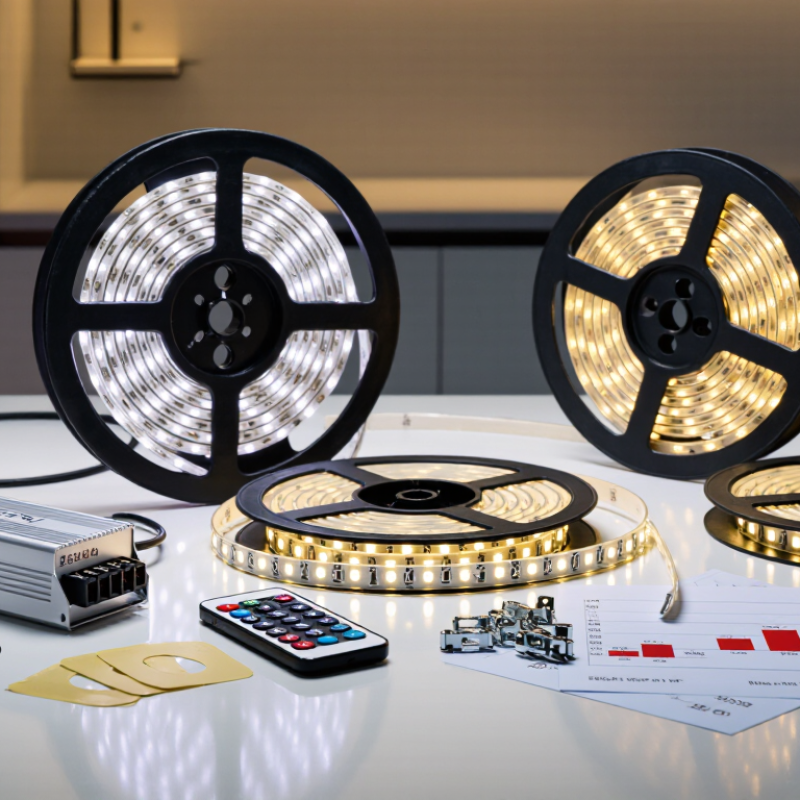
LED strip lighting comes in several forms, and the right choice depends on the space and the effect you need. SMD strips use small surface-mounted LEDs and suit many general lighting tasks. COB strips place LEDs close together, creating a more continuous line of light with fewer visible dots. RGB and RGBW strips offer colored output, while tunable-white versions shift between warm and cool white.
Common voltage options include 5V, 12V, 24V, and some 48V systems. Lower-voltage strips can work well for short accents, while 24V strips often allow longer runs before visible dimming. Still, length, copper thickness, and total load all matter. The arithmetic is simple. Long runs may need power injection at more than one point, and the power supply must match the strip’s voltage and wattage.
Specifications use shorthand that can obscure practical differences. IP rating describes resistance to dust and moisture, but the installation still determines what protection is appropriate. CCT, measured in kelvin, describes white-light color; CRI indicates how naturally colors appear under that light. PWM refers to a common dimming method, though control compatibility should be checked. A tidy datasheet cannot reveal every installation challenge. Small details matter.
For the same 24 W load and an assumed 0.1 Ω total circuit resistance, this model estimates voltage drop as a percentage of supply voltage. Higher-voltage systems draw less current at the same power, so the modelled percentage drop is lower. Actual results depend on strip power, wiring, and installation length; this comparison is illustrative, not a specification for every LED strip.
When comparing LED strip suppliers, start with the electrical details, not the product photos. A 12 V DC strip can suit short cabinet runs, while 24 V versions often reduce current and voltage drop over longer runs. Actual limits depend on wattage, copper thickness, and installation length. Check the supplier’s recommended maximum run; do not assume every 24 V strip performs alike.
Color temperature shapes the room’s feel. Around 2700 K gives a warm, lamp-like glow, while 6500 K appears cooler and more daylight-like. Some projects need both, but tunable-white strips require compatible controls and wiring. Small detail. Ask whether the listed range describes the LEDs themselves or the complete assembled strip.
CRI Ra ≥80 is a practical baseline for general lighting, though it may not render every color accurately. For retail displays, artwork, or makeup areas, request fuller color data, including R9 where available. I have seen buyers focus on CRI and miss the power supply’s output rating. Request current datasheets, test conditions, and tolerance ranges from each supplier. One specification can still leave questions. Check samples under the intended diffuser, since a bright workbench test may not resemble the final installation.
A credible LED strip supplier should explain its IEC 60529 IP rating with test documentation, not just a label on a product page. The first digit describes protection against solid objects and dust; the second addresses water exposure. For example, IP65 means dust-tight protection and resistance to water jets, not suitability for immersion. Check whether the rating applies to the complete assembly, including connectors and cut ends. Small details matter.
Efficacy needs the same careful review. Ask for measured lumens per watt, test conditions, strip length, and operating temperature. Compare products at the same color temperature and power level; otherwise, the figures may mislead. A sample can look bright on a cool showroom bench. It may behave differently inside a warm aluminum channel. Request independent test reports when available, and check whether claimed output is measured for the strip alone or a complete lighting system.
Quality controls reveal how reliably a supplier can repeat its results. Ask about incoming LED inspection, solder-joint checks, binning consistency, and burn-in sampling. Request batch records and warranty terms in writing. For a practical check, run a sample for several hours and inspect color shifts, hot spots, and adhesive lift. Datasheets still miss things. I have seen neat specifications leave installation questions unanswered, so evaluate documentation alongside the physical sample.
A useful worldwide comparison of LED strip lighting suppliers should focus on product strengths, not catalog size alone. The ten supplier profiles worth comparing often cover flexible indoor strips, weather-resistant outdoor models, high-density LEDs, and COB strips with smoother light lines. Others specialize in RGB or RGBW color effects, tunable white, addressable pixels, low-voltage systems, high-voltage runs, or custom lengths. Each type solves a different installation problem. A bright strip is not always the right strip.
Look closely at technical details. Check the stated color temperature, color-rendering data, power use per meter, cut intervals, and operating temperature. For damp locations, review the protection rating and installation requirements rather than relying on “waterproof” wording alone. Ask whether the supplier provides compatible drivers, connectors, and clear test reports. Sample testing matters: a strip may look even in a short display but show visible brightness changes across a longer run. That detail is easy to miss.
Tips: Request a sample reel and test it with the intended power supply. Confirm warranty terms, stock availability, and lead times in writing. Compare the actual light output, not just wattage. A supplier’s specialty can be useful, but documentation and support still need checking. Some specifications remain unclear until you ask directly.
An overview of common supplier profiles and sourcing markets. These entries describe supplier types rather than named or ranked companies; product specifications and certifications vary by supplier and SKU.
| Supplier profile | Common sourcing market | Typical product range | Common specialty | Best suited for | Buyer checks |
|---|---|---|---|---|---|
| 1. High-volume OEM/ODM manufacturer | Mainland China | Flexible LED tape, single-color, tunable-white, RGB and RGBW strips | Broad customization options, including PCB width, LED density, reel length and packaging | Large-volume projects and private-label sourcing | Sample consistency, production capacity, component traceability and applicable safety documentation |
| 2. Custom-engineered strip specialist | East Asian manufacturing hubs | Custom-voltage, custom-cut and application-specific LED strips | Design support for dimensions, connectors, control methods and installation constraints | OEM products and non-standard project requirements | Engineering-change control, minimum order quantities and sample-to-production matching |
| 3. Premium component-focused supplier | Japan and South Korea | White-light strips and color-tunable products for indoor lighting | Emphasis on consistent color appearance and documented performance options | Design-led commercial and architectural installations | Request the relevant color-rendering, chromaticity, lifetime and thermal test data for the exact SKU |
| 4. European project-oriented supplier | Germany and neighboring European markets | Indoor linear-lighting strips, compatible profiles and control accessories | Project documentation and integration with regional lighting specifications | Commercial fit-outs and specification-driven projects | Confirm applicable EU market documentation, warranty terms and local technical support |
| 5. Architectural lighting specialist | Italy and wider European market | Flexible strips, linear-lighting components and decorative lighting systems | Integration of light output, form factor and installation accessories | Hospitality, retail and interior-design applications | Check photometric files, mounting details, dimming compatibility and project lead times |
| 6. North American distribution-focused supplier | United States and Canada | Common-voltage LED tape, power supplies, dimmers and installation accessories | Regional stock availability and sales support for installers | Contractors needing accessible inventory and local service | Verify product listing and certification status, stocked lengths, returns and warranty coverage |
| 7. Outdoor and wet-location specialist | Global sourcing markets | Coated or encased LED strips and compatible sealed connectors | Products designed for specified moisture or dust exposure conditions | Outdoor accents, signage and damp-location installations | Confirm the IP rating of the complete assembly, including cut ends and connections; check UV and temperature limits |
| 8. Smart-control and color-effects supplier | Asia, Europe and North America | RGB, RGBW, addressable strips and compatible controllers | Dynamic effects and integration with supported control systems | Entertainment, retail displays and connected lighting projects | Check protocol compatibility, controller limits, power injection needs and software support |
| 9. Flexible low-voltage specialist | China, Taiwan and other Asian markets | Flexible 12 V or 24 V LED tape in multiple widths and LED densities | Compact formats for coves, cabinets, signage and furniture | Installations with restricted space or custom cut lengths | Confirm voltage drop, cut intervals, current draw and suitable driver sizing for the installed length |
| 10. Regional assembler and project integrator | India, Southeast Asia and local markets worldwide | LED strips, cut-to-length assemblies, wiring and project kits | Local customization, assembly and coordination with installation teams | Regional projects that benefit from local delivery and service | Assess component sourcing, batch testing, replacement availability and documented assembly procedures |
A useful comparison of LED strip lighting suppliers starts with evidence, not a polished catalog. Ask for current certificates and test reports for the exact strip model, not a similar product. Requirements vary by destination and application, so check that the documentation matches your market. Small detail, big risk.
Customization affects both fit and consistency. Confirm voltage, PCB width, color temperature, CRI, cut length, connector type, and ingress protection rating. Request a sample with the specified adhesive and dimmer before approving a large order. A sample can look perfect on a workbench, yet behave differently in a warm cabinet or long installation run. That mismatch is easy to underestimate.
Lead-time quotes should separate sample approval, production, and shipping. Ask which components are stocked and what happens if one is delayed. Global reach means more than a list of countries; check shipping options, export paperwork support, and whether technical help works in your time zone. Compare these details in writing. Honestly, the lowest quote may still be the least predictable option. I would leave room for uncertainty: schedules change, and a supplier’s estimate is not a guarantee.
